





Disruption in the Portfolio
Updated : September 8th, 2026
How Families Invest in Innovation Within a Goals-Based Framework
Modern portfolio construction for ultra-high-net-worth families has evolved well beyond the traditional risk-return optimization frameworks that dominated institutional investing for decades. Models such as Modern Portfolio Theory, the Capital Asset Pricing Model, and the concept of an efficient frontier may remain intellectually important, but they are not always easily accessible to the typical investor. These concepts were designed by investment professionals to help optimize portfolios for institutions such as pension plans, endowments, and foundations, which generally have relatively singular objectives and clearly defined liabilities. Families, however, experience and steward their wealth very differently.
At Richter Family Office (RFO), our experience working with multi-generational families has shown that portfolio construction must do more than maximize expected returns for a given level of volatility. It must support a wide range of financial goals, emotional priorities, and long-term responsibilities, many of which extend far beyond any single market cycle. As a result, we approach portfolio construction in part through a goals-based framework, integrating institutional analytical rigour within a structure that reflects how families actually experience and steward wealth across generations.
Key Takeaways
- Goals-based investing aligns capital with purpose. Different portions of family wealth can be structured around distinct objectives, time horizons, and levels of risk.
- Disruption can play a deliberate role within a broader portfolio. A dedicated allocation can provide exposure to transformative long-term themes without compromising the stability of the overall portfolio.
- Private markets can provide important access to innovation. Many disruptive technologies and business models develop before companies reach the public markets, increasing the importance of manager selection, governance, and due diligence.
- Investment governance enables responsible risk-taking. Clear parameters around allocation, oversight, and decision-making allow families to pursue higher-risk opportunities within the context of their broader financial and generational objectives.
Why Goals-Based Investing Matters for Families
Unlike institutions, families do not view their wealth as one undifferentiated pool of capital. Research and experience suggest that families naturally segment wealth into layers, each with a distinct purpose, time horizon, and risk tolerance. These layers often include capital earmarked for financial security and lifestyle needs, capital designated for long-term growth, and capital intended to express aspiration, conviction, or legacy.
First developed in the 1990s by academics Hersh Shefrin and Meir Statman¹, the goals-based framework explicitly recognizes this reality. Rather than forcing all assets into a single risk-return optimization exercise, the portfolio is structured so that each allocation aligns with a specific objective. In this way, families gain greater clarity about what each component of their portfolio is meant to achieve, reducing the likelihood of emotionally driven decisions during periods of volatility or uncertainty.
Within this framework, RFO combines the discipline of institutional portfolio analytics with an understanding of the psychological and aspirational dimensions that are inseparable from family wealth. The result is a portfolio architecture that is both analytically sound and purpose-driven, designed to endure across market regimes and generational transitions.
Where Does Disruption Fit Within a Goals-Based Portfolio?
One of the most distinctive elements of a goals-based portfolio for families is the aspirational bucket: the portion of capital allocated to high-growth, long-duration opportunities that carry elevated risk but offer asymmetric upside. It is within this aspirational tier that Richter Family Office deliberately defines what we refer to as the disruption bucket.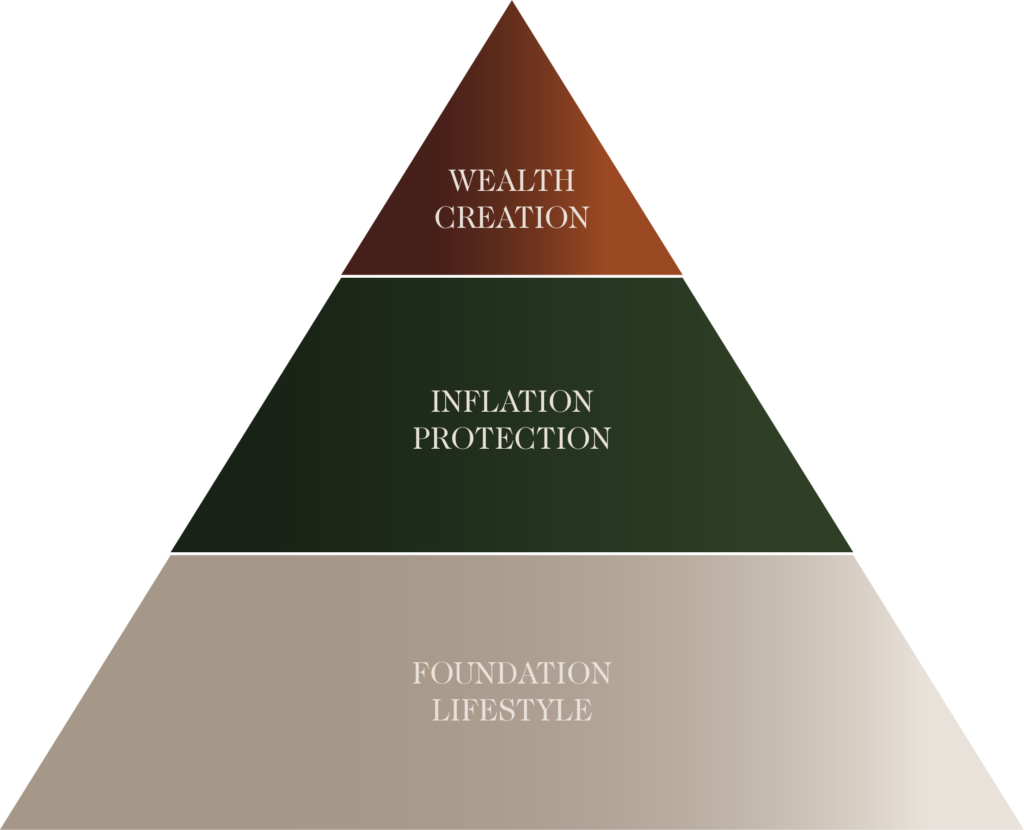
The disruption bucket is not a tactical allocation to the latest trend, nor an incidental by-product of venture or growth investing. It is an intentional, explicitly sized component of the portfolio designed to provide exposure to secular, transformative forces shaping the global economy. These forces may include technological innovation, energy transition, healthcare advancement, frontier science, or other long-horizon themes capable of creating outsized value over time.
Critically, the disruption bucket serves two functions. Financially, it seeks asymmetric return potential that can meaningfully influence long-term outcomes. Philosophically, it allows families to express conviction by investing in areas aligned with their worldview, entrepreneurial instincts, or sense of purpose. By carving out a dedicated allocation, families can participate meaningfully in innovation without compromising the stability of the broader portfolio.
Why Disruption Requires a Different Investment Discipline
Disruption-oriented investments differ fundamentally from traditional asset allocations. They are typically long-duration, idiosyncratic, and often illiquid, with outcomes driven less by market beta and more by execution quality, competitive advantage, and powerful structural tailwinds.
In our experience, many of the most compelling disruptive opportunities are more likely to be found in private markets. By definition, transformative technologies and business models tend to emerge in the earlier stages of a company’s lifecycle, before they are fully understood, widely adopted, or appropriate for public-market scrutiny. In parallel, structural shifts in capital markets have enabled companies to remain private for longer, supported by deeper pools of private capital and reduced reliance on public listings. As a result, an increasing share of long-term value creation now occurs prior to an IPO.
For families allocating capital to disruption within a goals-based framework, private markets therefore represent a critical access point, offering exposure to innovation at a stage when its impact may be most pronounced, but also when governance and due diligence are most essential. While the potential rewards can be significant, these investments may offer limited or no off-ramps if early decisions prove incorrect, amplifying the importance of getting those decisions right at the outset.
For these reasons, we believe the disruption bucket requires a disproportionately higher level of manager research and due diligence. In many cases, the ultimate investment outcome is determined less by the thematic exposure itself and more by the expertise, alignment, and operational involvement of the manager or partner providing access. Surface-level exposure or headline familiarity with a sector is insufficient when capital may be committed for extended periods and the consequences of misjudgment can be difficult to reverse.
At RFO, this reality fundamentally shapes how we evaluate opportunities within the disruption bucket. We place significant emphasis on manager pedigree, sourcing advantage, alignment of incentives, and the ability to actively influence outcomes, not merely the ability to participate alongside them. This disciplined approach enables families to engage with emerging areas of innovation thoughtfully and deliberately, grounding conviction in proper governance and decision-making rather than enthusiasm alone.
How Investment Governance Enables Responsible Risk-Taking
The defining feature that allows families to pursue disruption thoughtfully is a formal investment governance framework. Governance helps ensure that high-risk, high-reward decisions are made deliberately, in context, and with full awareness of their implications.
Within RFO’s investment governance framework, disruption investments are evaluated not in isolation, but alongside broader considerations such as tax structuring, cash-flow demands, estate planning, and generational objectives. Governance establishes clear parameters around position sizing, decision authority, review processes, and risk oversight, providing families with confidence that aspirational capital is being deployed responsibly.
Importantly, governance does not constrain innovation. On the contrary, it enables conviction by creating a structured environment in which families can take calculated risks without jeopardizing long-term stability. This is a critical distinction between RFO’s approach and that of banks, money managers, or investment-only advisors, which may not have either the independence or the technical breadth required to integrate investment decisions with the broader family enterprise.
Investing in Disruption With Discipline and Purpose
A thoughtfully constructed disruption bucket allows families to participate in the most transformative forces shaping the global economy while remaining anchored to their long-term goals and responsibilities. When embedded within a goals-based portfolio and supported by rigorous governance and due diligence, disruption can become a powerful complement rather than a destabilizing force.
At Richter Family Office, we view disruption not as an investment trend to be chased, but as an aspirational allocation to be governed. By integrating institutional-grade investment oversight with family-centric objectives, we help families invest in innovation with clarity, discipline, and purpose, positioning them to shape outcomes not just for the next market cycle, but for generations to come.